

Sean Tascatan, CFA
Chief Investment & Growth Officer
Nest Wealth Asset Management Inc.
Tascatan joins Nest Wealth with over 15 years of investment management experience, including serving as lead portfolio manager on award-winning funds and helping manage multi-billion-dollar portfolios. He previously held senior roles at Starlight Capital, Sentry Investments and BMO Private Wealth. At Nest Wealth, he is leading investment strategy and asset allocation.
The 60/40 portfolio isn’t broken. But is it the only way to build a well-diversified portfolio?
Some of the world’s largest pension plans and sovereign wealth funds are changing how they invest, looking beyond individual asset classes to assess how every investment contributes to the portfolio as a whole.
Known as the Total Portfolio Approach (TPA), this framework shifts the focus from how much to hold in stocks and bonds to how all investments work together to achieve the portfolio’s objectives.
Looking beyond 60/40 means focusing on diversification and a clear role for every investment, all guided by our clients’ goals.

How the world’s largest investors are rethinking portfolios, and what it means for yours
For decades, the 60/40 portfolio has been the default starting point for long-term investors. Put about 60% in stocks for growth and 40% in bonds for stability, then rebalance from time to time. It is simple, easy to understand and, for long stretches of time, it worked well.
Over the past several years, however, some of the world’s largest investors, including major pension plans and sovereign wealth funds, have been changing how they build portfolios. Their approach is called the Total Portfolio Approach, or TPA. Here is what it is, why institutions are moving toward it, and what it means for you.
The traditional recipe
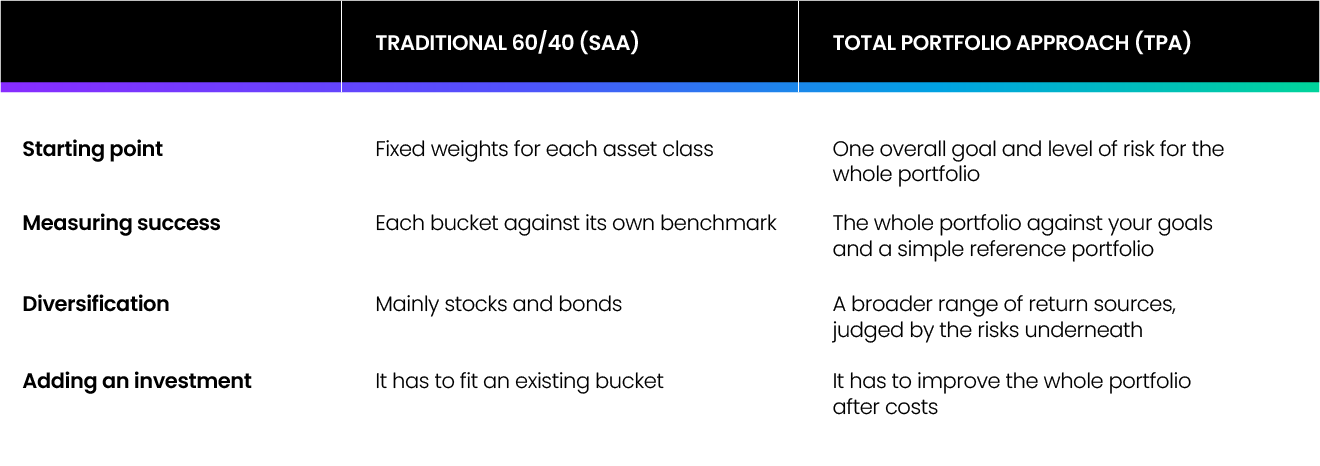
The 60/40 portfolio is the best-known example of Strategic Asset Allocation, or SAA. Think of it as a fixed recipe. You decide in advance how much goes into each ingredient, usually stocks and bonds, and you keep those proportions over time. Each part is managed in its own bucket and measured against its own benchmark.
The strength of SAA is discipline. Its weakness is that it assumes the ingredients will keep behaving as they have in the past, and in particular that bonds will hold up when stocks fall.
What happened in 2022
Most recently, that assumption was tested in 2022. As central banks raised interest rates sharply to fight inflation, stocks and bonds fell at the same time. Morningstar’s benchmark for a U.S. 60/40 portfolio lost 15.3% that year, only about four percentage points better than the 19.4% decline in the U.S. stock market.1 The lesson is not that stocks and bonds have stopped working. They remain the foundation of most portfolios. It is that relying on just two sources of return can leave investors exposed when both are hit by the same forces.
The Total Portfolio Approach, in plain language
TPA starts with a different question. Instead of asking how much belongs in stocks versus bonds, it asks: what is this portfolio trying to achieve, and does each investment help get it there?
Think of a hockey team. You would not build it entirely from goal scorers. You need defence and a goalie too, and you judge each player by how they help the team win. TPA treats a portfolio the same way: every holding is judged by what it adds to the whole portfolio’s risk, return, liquidity and diversification.
In practice, a few core ideas do most of the work:
- One goal for the whole portfolio. Rather than separate targets for every bucket, the portfolio is managed toward a single overall objective and level of risk.
- A simple yardstick. Many institutions compare themselves with a low-cost “reference portfolio” of stocks and bonds. Anything more complex has to earn its place by improving on that simple alternative after costs.
- Looking beneath the labels. Two investments with different names can carry the same underlying risk, such as sensitivity to rising interest rates. TPA looks at the drivers underneath so the portfolio is diversified in substance, not just on paper.
- Inflation-protection strategies are designed to help preserve purchasing power over time.
- Competition for capital. Money goes where it is expected to do the most for the whole portfolio, not where tradition says it belongs.
What institutional investors are doing
Canada’s largest pension plan is a well-known example of total portfolio thinking. CPP Investments anchors the base CPP to a simple mix of 85% global equities and 15% Canadian government bonds, which sets the level of market risk the fund aims to take.2 Its actual portfolio looks very different. As of March 31, 2026, CPP Investments held 36% in public equities, 22% in private equities, 20% in real assets such as real estate, infrastructure and energy, 13% in government bonds and 9% in credit.3 In other words, about half of the fund sits outside public stocks and government bonds. According to BMO Global Asset Management, writing in 2024, all but one of Canada’s other “Maple Eight” pension funds allocate more than 40% to alternative investments.4
In the United States, CalPERS, the country’s largest defined-benefit public pension fund, voted in November 2025 to adopt TPA, which replaced its strategic asset allocation model on July 1, 2026. CalPERS now judges performance against a single reference portfolio of 75% equities and 25% bonds rather than 11 separate asset-class benchmarks, a change it said would improve transparency and make performance simpler to judge.5,6 Australia’s Future Fund and the New Zealand Superannuation Fund are longer-standing adopters, and the CFA Institute notes that evidence from these funds suggests TPA strengthens governance alignment and increases portfolio resilience.7
This is an evolution, not a stampede. Based on a preliminary assessment of the world’s 100 largest asset owners, 8 use TPA, 66 still use strategic asset allocation and 26 sit somewhere in between.7
Introducing liquid alternative strategies
Through partnerships with some of the largest and most respected names in Canadian investment management, we are broadening the range of investment strategies that have historically been out of reach for most Canadian retail investors. The diversifying sleeve of the portfolio will include liquid alternatives, which bring institutional-style risk and return patterns into an accessible format. Pension funds, including CPP Investments, have used hedge-fund-style strategies for nearly two decades to reduce correlation to traditional markets and build more resilient portfolios.8
As liquid versions have become accessible, they have become an increasingly important building block for robust, diversified portfolios.9 Each strategy plays a distinct role and below are a few options we may consider:
- Equity long-short strategies aim to generate returns that are less dependent on the direction of stock markets, seeking to participate in market gains while dampening exposure to broad equity drawdowns.
- Market-neutral strategies seek to limit directional market exposure, with returns driven primarily by security selection rather than by whether markets rise or fall.
- Alpha-generating strategies seek idiosyncratic sources of return that are intended to have low correlation with broad equity and fixed-income markets, rather than simply providing market exposure at a higher fee.
- Inflation-protection strategies are designed to help preserve purchasing power over time.
- Multi-strategy approaches combine several complementary investment approaches to diversify return sources and reduce reliance on any single market or factor.
Separately, we are evaluating whether real assets, such as infrastructure, real estate, and commodities, as well as private equity, could complement traditional public-market exposures in appropriately designed portfolios. These asset classes may provide differentiated return and income sources, potential inflation sensitivity, and long-term growth potential10, while also incorporating distinct considerations such as liquidity, valuation, complexity, and investment horizon.
The goal is broader diversification with the intended result of more ways to generate returns, less dependence on stocks and bonds alone, and a greater emphasis on downside risk. The early evidence supports the direction. Industry commentary highlights how selected alternative strategies may complement a traditional stock-and-bond portfolio by broadening diversification, including during periods when stocks and bonds move together, with their potential contribution evaluated in terms of both risk and return.1,5
Our philosophy is to manage risk deliberately, with the aim of preserving capital while pursuing long-term growth.
Why they are moving away from 60/40
- Stocks and bonds do not always offset each other. When inflation and interest rates drive both markets, a two-ingredient portfolio has fewer places to hide.
- Silos can work against each other. Managed separately, buckets can build up overlapping risks unnoticed.
- Clearer accountability and flexibility. A single, simple benchmark shows whether added complexity and cost are adding value, and without rigid buckets, teams can pursue the opportunities that best serve the whole portfolio.
What this means for individual investors
Individuals should not simply copy a pension fund. Pension plans can lock money away for decades and use borrowing; individuals need access to their money, have taxes to manage and feel every market swing personally. The core ideas, however, translate well:
- Broader diversification. Liquid alternative strategies, available in everyday investment accounts, can add sources of return that behave differently from stocks and bonds. They carry their own risks and cannot eliminate losses.
- Every holding has a job. Each investment has a clear role: growth, stability, diversification or inflation protection.
- An honest comparison. A simple, low-cost mix of stocks and bonds is the yardstick. Anything more complex should earn its place after fees.
- A focus on your goals. Benchmarks still matter, alongside whether your portfolio fits your goals, time horizon and the risk you are willing and able to take.
How Nest Wealth is applying these ideas
We are taking a measured path. Our portfolios are evolving toward an approach known as Enhanced Strategic Asset Allocation7: we keep clear strategic allocations, benchmarks and investment limits, while adopting selected TPA principles, especially a closer look at how each investment works with the rest of your portfolio. An illustrative mix of roughly 40% public equities, 30% fixed income and 30% liquid alternatives shows the direction; your own mix will reflect your objectives, risk profile, time horizon and liquidity needs. This is the first step in a multi-year evolution.
The bottom line
The 60/40 portfolio is not broken. It is a sensible starting point. What the world’s largest investors have learned is that the better question is not how much to hold in stocks versus bonds, but how everything in a portfolio works together to reach a goal. That is the thinking we are bringing to our clients.
For general information only; not investment, tax or legal advice. Investing involves risk, including loss of principal. Diversification and alternative strategies do not guarantee a profit or protect against loss. Past performance is not indicative of future results. Allocations shown are illustrative only.
“Nest Wealth” is the trade name of Nest Wealth Asset Management Inc. The products and services advertised are designed specifically for investors in the provinces of AB, BC, MB, SK, PE, NB, NL, NS, QC and ON and may not be available to all investors. Products and services are only offered in accordance with applicable laws and regulations.
Source:
1. Morningstar, Lauren Solberg, “Don’t Lose Faith in the 60/40 Portfolio” (Jan. 25, 2023). https://www.morningstar.com/markets/dont-lose-faith-6040-portfolio
2. CPP Investments, Annual Report 2025, pp. 16–17 (Market Risk Targets and Benchmark Portfolios). https://www.cppinvestments.com/wp-content/uploads/attachments/CPP-Investments-F2025-Annual-Report-English.pdf
3. CPP Investments, “CPP Investments Net Assets Total $793.3 Billion at 2026 Fiscal Year End,” news release, Asset Class Composition chart (May 21, 2026).
https://www.newswire.ca/news-releases/cpp-investments-net-assets-total-793-3-billion-at-2026-fiscal-year-end-814459989.html
4. BMO Global Asset Management, “Bridging the ‘alternatives gap’” (June 2024). https://bmogam.com/ca-en/insights/bridging-the-alternatives-gap/
5. CalPERS, “CalPERS Board Adopts Streamlined Investment Approach to Seize Market Opportunities,” news release (Nov. 17, 2025). https://www.calpers.ca.gov/documents/202606-invest-agenda-item05a-10-a/download?inline
6. CalPERS, Public Employees’ Retirement Fund Investment Policy, effective July 1, 2026. https://www.calpers.ca.gov/newsroom/calpers-news/2025/calpers-board-adopts-streamlined-investment-approach-to-seize-market-opportunities
7. Roger Urwin and Genevieve Hayman, “The Total Portfolio Approach (TPA): A Practical Guide for Navigating the Transition to TPA,” CFA Institute Research and Policy Center (July 2026). https://rpc.cfainstitute.org/sites/default/files/docs/research-reports/fti_tpa-report_online.pdf